
NESTER PLAY / ON-COURT GUIDES
Points. Games. Sets.
Let’s make it clear.
Understand the score before you choose the format for your next session.
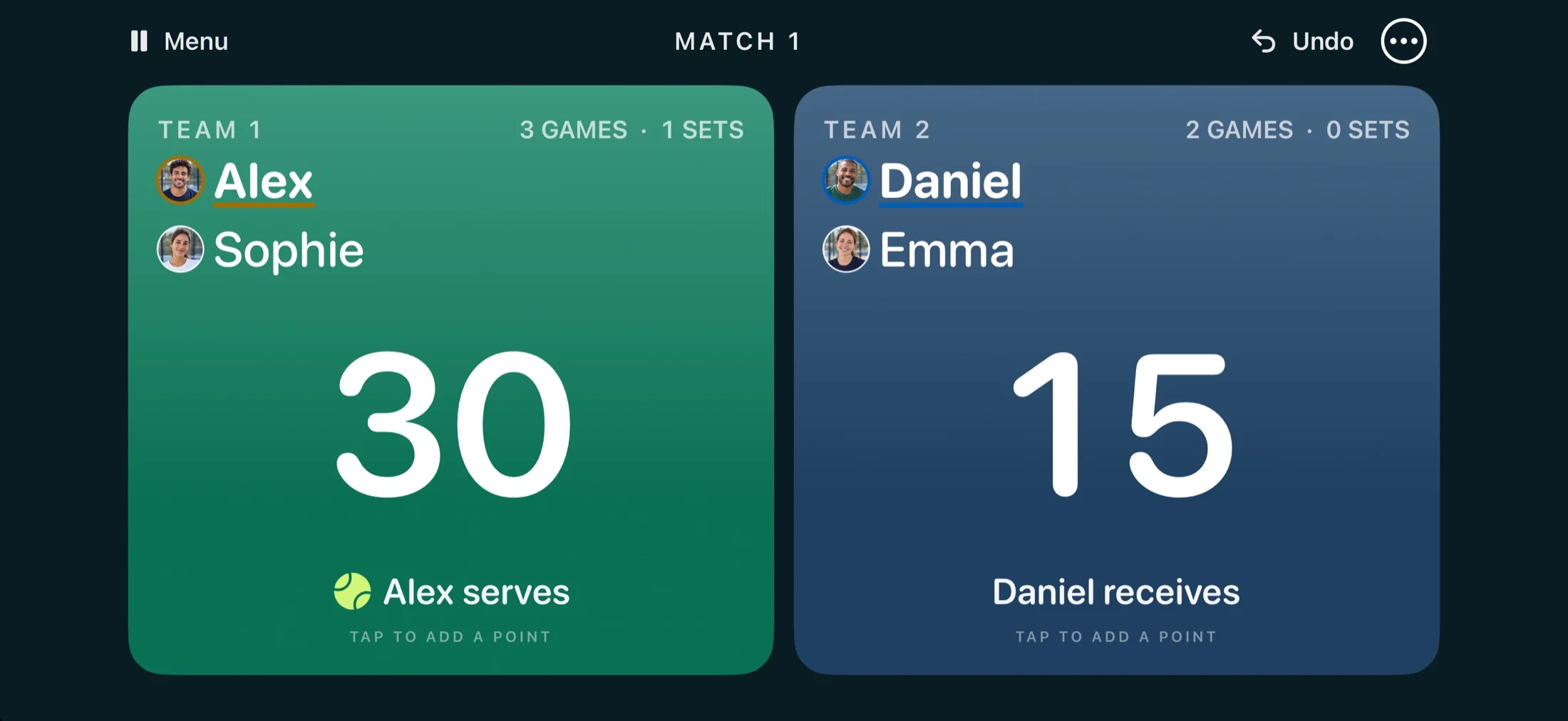
How do points work in padel?
In the usual scoring sequence, a pair’s points are called 0, 15, 30 and 40. Winning the next point normally wins the game. The extra rule you agree for 40–40, called deuce, decides what happens when both pairs have won three points.
| Points won | Score called |
|---|---|
| 0 | 0, or love |
| 1 | 15 |
| 2 | 30 |
| 3 | 40 |
| 4 | Game, unless the deuce format requires more points |
Advantage, golden point and Star Point
Advantage scoring: at deuce, a pair needs two consecutive points. The first gives advantage; the second wins the game. Losing the advantage returns the game to deuce.
Golden point: a deciding point at the first deuce replaces the repeated advantage cycle. Agree the format and receiving-side choice before playing.
Star Point: the 2026 FIP rules include another format. If two advantages are lost, a deciding point is played at the third deuce. The LTA’s 2026 referee guide explains where this applies in its competitions. Follow your competition’s rules rather than assuming every padel match uses the same deciding point.
The option labelled golden point in the development app plays an advantage first. If that advantage is lost, the next point decides the game. That is a custom casual format, not standard golden point or the 2026 Star Point format.
How many games are in a set?
A conventional set is first to six games with a two-game lead, normally with a tie-break at 6–6 under the applicable rules. A best-of-three match is won by the first pair to take two sets. It can finish in two sets; three are not guaranteed.
A session is the time your group spends playing together. It can contain several matches. This distinction matters for team rotation: in Nester Play, a chosen lineup is kept for the selected number of completed matches, not swapped midway through a set.
What scoring does Nester Play currently use?
| Setting | How it works |
|---|---|
| Games per set | Choose 1–6. First to that number wins the quick set, without a tie-break or two-game margin. |
| Sets per match | One set, best of three, or best of five. Best of three is the default. |
| Deciding point off | Advantage scoring continues at deuce. |
| Deciding point on | One lost advantage arms the deciding point. |
These settings are for your casual group session. The current app should not be described as a complete competition-rules engine. If you are playing a sanctioned event, use the organiser’s required format and scoring system.
Keep the score useful for everyone
Say the score clearly between rallies. Choose one organiser to enter points, and correct a mistaken point with Undo before continuing. Check the next server and receiver when the app pauses between games.
For a group larger than four, plan the rest turns first. Our five- and six-player rotation guide gives practical examples. If you prefer to score from your wrist, see the Apple Watch guide.
Rules references
Reviewed by the Nester Play team on 29 October 2026. The distinction between official rules and the app’s format is based on the current app implementation and these governing-body sources.